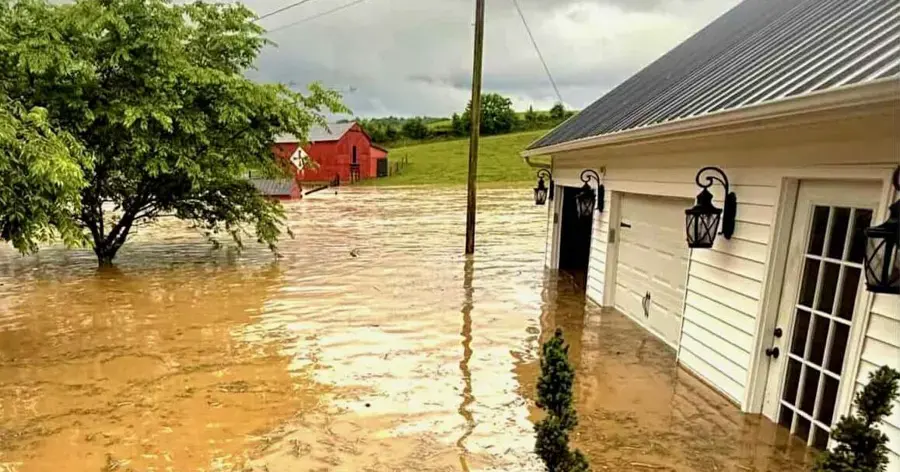
Drakes Creek runs through Hendersonville on its way to Old Hickory Lake, and on the days when heavy rain falls, that creek swells fast. On March 27, 2021, about four to five inches of rain fell on Hendersonville in one day.
Key takeaways
- Creek flooding is Category 3 water, the same classification as sewage backup, and requires protective gear and special cleanup that differs from a supply-line leak.
- Drakes Creek has flooded repeatedly, including three times in early 2025, so extraction and moisture checks start as soon as the water recedes.
- Clay soil holds water against crawl space walls and footings after heavy rain, which can extend the drying timeline.
- Foundation type is not recorded for the city as a whole, so each homeowner should check what sits under the house, whether a crawl space, a slab or a walkout on a sloped lot.
- Contaminated floodwater damages anything it touches: food, medications, paper goods, textiles and the interior surfaces of walls below the waterline all require removal.
When Drakes Creek and Old Hickory Lake flood Hendersonville
Drakes Creek Park flooded, Memorial Park and Mallard Point Park took water, and firefighters rescued two teenagers from Drakes Creek near Durham Farms. By April 2025, Drakes Creek Park had flooded three times already that year.
Durham Farms, a master-planned community built after 2016, sits right beside the creek, and homes near Drakes Creek and Station Camp Creek can take water into ground-level rooms and crawl spaces when the creek rises.
Here is what those homeowners should check after the rain stops and what makes floodwater different from a leaking roof.
Drakes Creek flows through Hendersonville into Old Hickory Lake, and Drakes Creek Park sits in a known flood zone.
In May 2010, the Army Corps of Engineers opened all the floodgates on Old Hickory Dam, releasing more than 200,000 cubic feet of water per second, and Drakes Creek Park and lake water came over Gallatin Road.
In that same flood, the dam came within 6.6 inches of overtopping its lock wall. On March 27, 2021, firefighters pulled two teens out of Drakes Creek near Durham Farms.
By April 4, 2025, the creek had flooded the park three times that year, canceling tournaments and events.
Station Camp Creek runs through the Wynbrooke and Saundersville side of town, where homes date from 2000 to the present, and it is named as a flooding source in the Sumner County Flood Insurance Study.
Memorial Park and Mallard Point Park along Sanders Ferry Road also take floodwater.
When a creek rises and the surrounding soil becomes saturated, water can reach ground-level rooms and crawl spaces from outside and from below, and the drying that follows takes longer than after a surface spill.
Creek water is not the same as a rain leak
Water from Drakes Creek that enters a home carries silt, sediment and soil from its banks.
It is treated as Category 3 contamination, which means protective gear is required for anyone in contact with it, and materials that absorbed it often cannot be cleaned and must be removed.
A roof leak or a supply-line rupture inside the house produces cleaner water that usually stays in one area. Creek water that enters a home spreads across the floor and coats walls and framing with mud and silt.
Items below the waterline are typically removed rather than cleaned, because porous materials cannot be reliably cleaned once contaminated.
- Creek water is Category 3 contamination and needs protective equipment and special handling.
- Water that stands even briefly can soak into insulation, subfloor and drywall.
- Mud and sediment coat everything and are difficult to clean from porous materials like insulation and drywall.
- Do not let anyone in the household touch the water without protective gear.
- Keep pets and children out of mud and standing water.
What to check in the crawl space and ground floor after high water
Once the creek recedes and the water level drops outside the house, a homeowner should check the foundation immediately. If the crawl space has standing water, the water extraction crew will need to pump it out.
Saturated soil around the foundation continues to push moisture into the space for days after the visible water has drained.
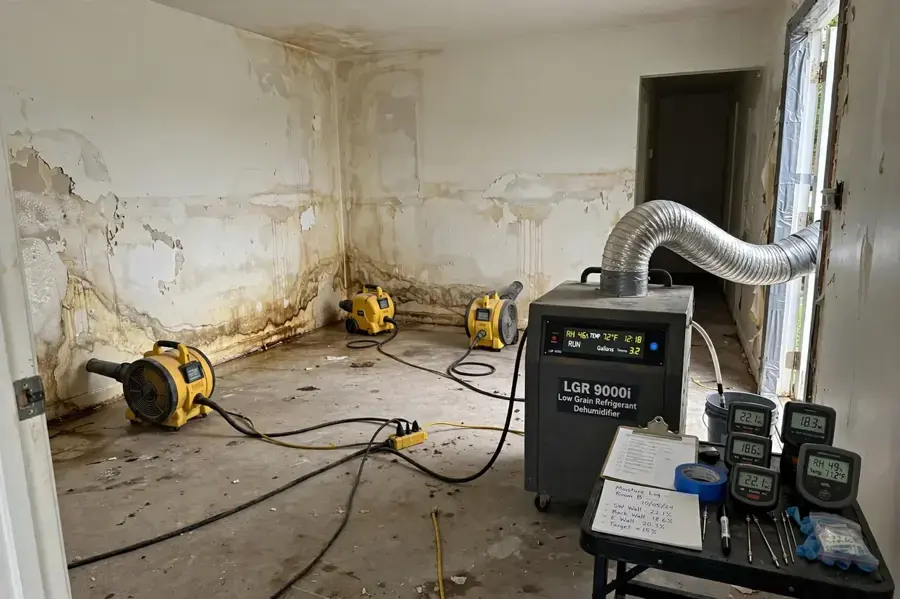
The drying team takes pin meter readings on the floor, the joists and the foundation walls to understand how wet the structure is.
Humid Hendersonville summers slow evaporation, and in clay soil that drains slowly, the saturated ground can keep pushing moisture upward after the visible water is gone.
- Check for standing water in the crawl space by looking through the access hatch with a flashlight.
- Look for a waterline on the foundation block or piers that shows how high the water rose.
- Feel for soft spots on the floor above the crawl space, which indicate wet joists and subfloor.
- On a lakefront lot with a walkout level, check walls for watermarks and feel the floor slab for dampness.
- Do not go into a flooded crawl space without protective gear, and do not touch electrical equipment that has been submerged.
The extraction crew's first moves
The extraction crew's first job after a creek flood is pumping out standing water. Submersible pumps are placed at the low point, and water is discharged outside. Once the water is gone, the crew assesses what is soaked.
Soaked insulation is usually removed, along with the vapor barrier if buried in mud. Surfaces may be treated with an antimicrobial.
This work is part of storm flood cleanup, which differs from cleanup after a supply-line rupture because all materials are treated as contaminated.
Drywall, cabinetry and stored items at or below the waterline are photographed and removed. What remains is a clean space ready for dehumidifiers and air movers to run.
- Pumping out the water is the first step, and large volumes can take time.
- Soaked insulation is removed, because wet batts stay wet even after drying has started.
- The vapor barrier and any wet lumber are noted and sometimes removed depending on the damage level.
- An antimicrobial may be applied to surfaces during drying.
- All removed materials are bagged and disposed of, with photos taken for documentation.
Why drying takes longer in Hendersonville clay soil
Soil over the limestone in Hendersonville is mostly clay, and clay holds water against crawl space walls and footings after heavy rain. After surface water from Drakes Creek has drained, the saturated ground can keep releasing moisture into the crawl space.
The drying team runs dehumidifiers and air movers and checks readings daily. Humid summers slow the process further.
The drying crew monitors wood moisture content until readings match a dry reference, and that, not the calendar, decides when equipment comes out.
- Clay soil holds water and can keep releasing it into the foundation space.
- Humid summer air slows evaporation.
- Dehumidifiers run continuously to pull moisture out of the air.
- Daily pin meter readings show when the equipment can be removed.
- Drying is complete when wood moisture matches a dry reference sample.
Insurance and flood coverage for creek water
Water from a flooded creek is treated as flood damage under most property insurance policies. Hendersonville takes part in the National Flood Insurance Program, and flood coverage is typically sold separately through that program or a private carrier.
Standard homeowners policies often exclude flood, so homeowners near creeks should confirm what their policy covers.
For insurance purposes, photographic documentation of the flood and all materials removed is essential. The restoration crew's report and photos support the claim. Flood damage claims typically cover the structure and some belongings, but the list of covered items varies by policy.
- Ask your insurance agent whether a separate flood policy covers the property.
- Many standard policies exclude flood entirely; a flood policy must be purchased separately.
- Document the water level on the walls with photos and video; the restoration crew will do the same.
After the water is gone: rebuild and resilience
Once the drying crew confirms the crawl space is dry, new insulation and a fresh vapor barrier go back in. For finished living space, reconstruction means new flooring, drywall and fixtures.
Some homeowners consider flood-resilient improvements during the rebuild: elevated electrical boxes, raising HVAC equipment off the floor, or installing a sump pump system.
For homes near Drakes Creek, the drying and reconstruction process is a reminder that creek flooding is a real hazard. Knowing what to do on the first day makes the next event less disruptive.
The Hendersonville town page lists the other water problems the area sees, and the crawl space service page covers what happens under the floor.
- Consider installing a sump pump if groundwater accumulation is common.
- Raise critical equipment and electrical systems above a known or expected flood level.
- Clear gutters and grade soil away from the foundation to reduce water accumulation after heavy rain.