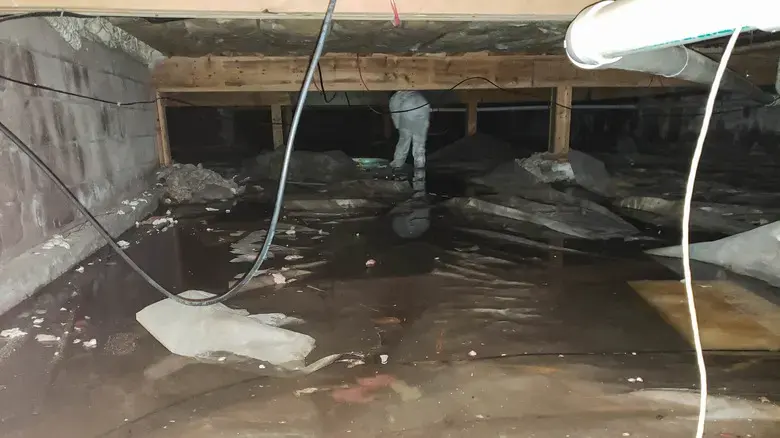
Most Mount Juliet homeowners find crawl space water the same way: a musty smell after a storm, a soft spot in the hallway floor, or a flashlight pointed through the access door at a vapor barrier that is suddenly shining.
Key takeaways
- Shining plastic or a waterline on the foundation block means standing water, not just damp air.
- Shut off power to anything electrical under the house before anyone goes in, and close the main if the water came from a pipe.
- Storm runoff and anything from a drain line are Category 3 water and need protective gear.
- The first jobs are pump-out, then pulling the soaked vapor barrier and sagging insulation.
- Drying is mostly dehumidification, and the joist readings decide when it ends.
Standing water or just damp air? How to tell from the hatch
On March 27 and 28, 2021, Mount Juliet took 6.88 inches of rain in about a day, and a storm like that is exactly when crawl spaces here take on water.
Here is how to read what you are looking at, what to do in the first few hours, and what the restoration team does once it arrives.
You do not need to crawl in to answer the first question. Open the access door, shine a strong flashlight across the floor and look for three things.
Damp air on its own leaves condensation on ductwork and a musty smell, but the plastic stays dull and the soil under it stays put. Standing water is different, and it changes what has to happen next.
- Reflection: a vapor barrier that shines like a pond, or plastic that floats and ripples, has water on top of it.
- Waterline: a dark band on the foundation block or the piers shows how high the water rose.
- Sagging insulation: fiberglass batts hanging low between the joists have soaked up water from below.
Hour one: what to shut off and what to leave alone
Many Mount Juliet crawl spaces hold more than framing. HVAC air handlers, ductwork, water heaters, supply lines and drain lines often run under the floor, and that is where the danger is.
If the panel and the area around it are dry, switch off the breakers for the crawl space unit and any outlets or lights down there. Do not crawl into standing water near anything electrical.
If the water is coming from a pipe rather than the storm, close the main shutoff; in many homes it sits where the water line enters the house or in the garage.
- Do: photograph the water from the hatch, note when you found it, and keep the access door closed afterward so humid air stays out of the house.
- Do not: run a household shop vac in the crawl space, pull the vapor barrier yourself, or turn the HVAC back on until the unit is checked.
- Do not: wait for it to soak in. On this ground, it usually does not.
Why Wilson County crawl spaces collect water
Wilson County sits on shallow limestone with thin soil over it, and cedar glades across the county are where that rock shows at the surface.
When a storm drops several inches of rain in a day, there is not much soil to soak it up.
The water runs along the rock toward the lowest point it can find, and a crawl space dug into a lot is often that point.
Nearby Lebanon averages about 54 inches of rain a year, so this is not a once-a-decade problem. Lots that slope toward the house, downspouts that dump next to the foundation and gutters that overflow in a downpour all add to it.
In March 2021 the same storm sent Town Creek over its banks on the Lebanon square; see crawl space water damage in Lebanon for how that town's creeks and karst ground play into it.
Clean, gray or black: naming the water
The category of the water decides how it is cleaned and what can stay. The restoration team sorts it by source before any equipment goes in.
- Category 1: a supply line or water heater leak under the house, caught quickly. Clean water, and most framing can simply be dried.
- Category 2: water from a washer or dishwasher drain line. It carries soil and detergent and needs cleaning and treatment.
- Category 3: storm runoff that crossed the yard, creek overflow, or anything from a sewer or drain line. Treat it as contaminated. Wear boots and gloves, keep children and pets away, and expect porous materials it touched to be removed. A drain line break under the floor follows sewage backup cleanup procedures.
What the restoration team removes first
The first visit is about getting the water out and stopping it from feeding moisture into the floor above. The extraction crew sets submersible pumps at the low point and pumps the standing water out, the same first move described under water extraction in Mount Juliet.
Then the soaked materials come out. A vapor barrier with water on top of it, or contaminated water under it, is pulled and bagged.
Fiberglass insulation that sagged with water is cut down, because wet batts stay wet and press moisture into the subfloor.
On a Category 3 loss, the crew applies an antimicrobial to the soil surface and the framing before drying starts.
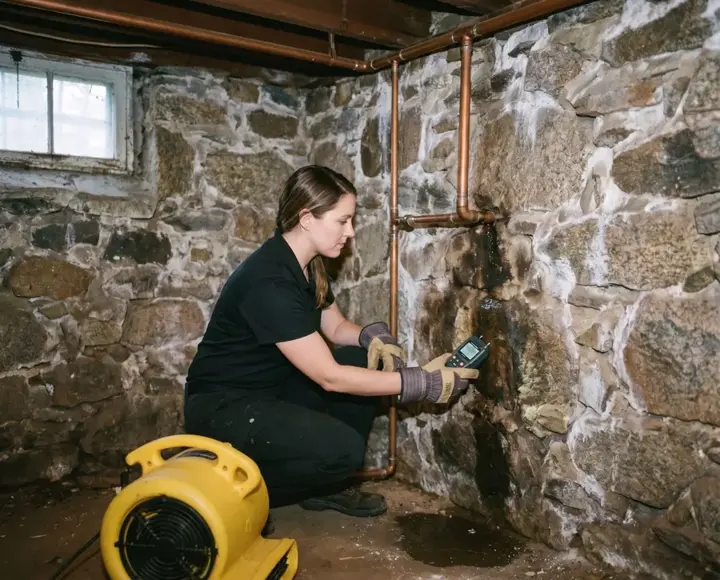
Before anything is removed, photos are taken from the hatch and inside the space, and the tech who does the walkthrough takes pin meter readings on the joists, the beams and the subfloor.
Those readings, compared with dry framing elsewhere in the house, set the drying goal.
Drying under the house: the next few days
Drying a crawl space is mostly dehumidification. An LGR dehumidifier pulls moisture out of the enclosed air while air movers push air across the framing.
Foundation vents are usually closed during drying so humid outside air does not undo the work, especially in a Middle Tennessee summer.
The drying team takes readings every day and adjusts the equipment. How long it takes depends on how soaked the framing and soil are. The goal is the same one used everywhere in the house: wet wood that matches a dry reference.
When the readings get there, the equipment leaves and a new vapor barrier can go down. The full process is laid out under crawl space water damage in Mount Juliet.
After it is dry: keeping the next storm out
Drying fixes the damage, not the cause. Once the space is dry, a few changes make the next heavy rain less likely to end up under the floor.
- Extend downspouts so roof water lands several feet from the foundation instead of beside it.
- Check the grading: soil should slope away from the house, not toward it.
- Replace the vapor barrier with one that runs up the foundation walls and is sealed at the seams.
- Look under the house after every big storm, and after any hard freeze if supply lines run through the crawl space.