Structural Drying in Goodlettsville, TN
After creek-area flooding near Mansker Creek or Long Hollow Pike, or a pipe that ran inside a wall, framing and subfloor stay wet long after the surface looks fine. The drying team sizes equipment by class, logs readings each day and removes it only when the numbers match.
(888) 849-5796Walls still wet? Call about drying- 24/7 dispatch
- IICRC S500 goal
- LGR dehumidification
- Daily psychrometric logs
First moves when a Goodlettsville structure is wet
- 1
Stop the source
Close the main or stop the leak, and keep out of standing water near outlets.
- 2
Remove the standing water
Water that sits on floors keeps feeding humidity into walls, so extraction comes before drying.
- 3
Keep the house closed
Close windows and run air conditioning if it is working, so humid outdoor air does not enter.
- 4
Take photos and notes
Record wet rooms, staining and the date water was found for the file.
A dry surface does not mean a dry house
Paint and carpet dry quickly, but studs, plates and joists hold water far longer. Measuring what is hidden is the difference between a finished job and a callback.
- Water category
- Set by the source: Category 1, 2 or 3
- Typical class
- Class 1 to 4, depending on what was soaked
- Equipment
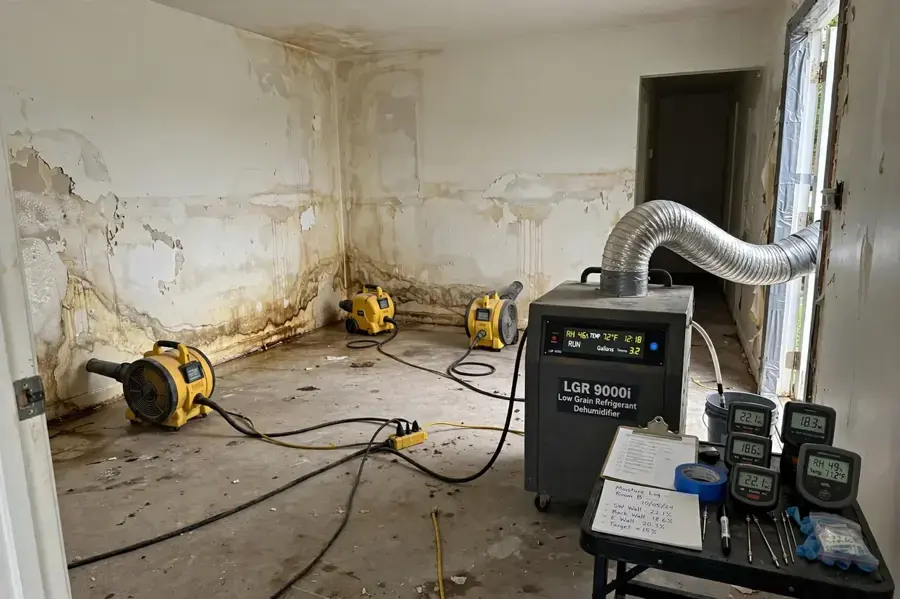
- LGR and desiccant dehumidifiers, air movers, thermo-hygrometers, pin and pinless meters
- Done when
- Wet materials land within 2 to 4 points of a dry reference
Structural drying is what happens once the visible water is gone and the moisture left in framing, subfloor, insulation and concrete has to be pulled out. In Goodlettsville the same work follows creek flooding near Mansker Creek and Long Hollow Pike, a split pipe or a leaking roof. The method is the same, and the readings prove it.
Sizing the equipment
The drying team measures the room and the materials, sorts the loss into Class 1 through 4 and sets air movers and dehumidifiers to match. A small room of wet carpet needs far less than a wall of soaked framing. Desiccant units come in when the air has to get drier than refrigerant machines can manage. Containment keeps cleaned areas apart from wet ones, and humid air is exchanged so it leaves the building instead of circling inside.
Dry the structure, not just the surface
(888) 849-5796Call about structural dryingReading, adjusting and repeating
Moisture and psychrometric readings are logged at marked points every day, and equipment is moved as the wet edge shrinks. Doors to unaffected rooms are closed so the equipment works on the wet zone alone, and a return visit each day lets the crew shift fans as the edge moves. That daily record is what lets the file show the structure was dried and not just aired out.
- Pin and pinless meters check wood and drywall.
- Thermo-hygrometers track temperature and humidity in the air.
- Thermal imaging confirms the wet edge is shrinking.
When drying ends
Equipment leaves when wet materials read within 2 to 4 points of a dry reference taken in the same house. After flooding, storm and flood cleanup comes first, and after a split pipe see burst pipe water damage. The Goodlettsville hub lists every service. Closing up too soon is how hidden moisture turns into swelling and odor, so the last readings are taken before drywall or flooring goes back.
What does structural drying cost in Goodlettsville, TN?
In Goodlettsville, TN, structural drying typically runs $1,000 to $8,000, mostly driven by how many days equipment runs, how much equipment the class of loss needs and how much area is wet. A light Class 1 or 2 job sits low, and a Class 4 job with dense materials sits high.
Class 1 to 2
$1,000 to $2,500
- Few materials wet
- Small equipment set
- Short run
Class 3
$2,500 to $5,000
- Walls and ceilings wet
- More dehumidifiers
- Longer run
Class 4
$5,000 to $8,000+
- Dense materials wet
- Desiccant units
- Extended equipment days
Cost follows the loss class, the area that is wet and the number of days equipment has to run before the readings clear. Run the numbers in the water damage cost calculator.
How structural drying is handled in Goodlettsville
- 1
Classify the loss
Water source, materials and area decide the class and the equipment count for the job.
- 2
Place and balance
Air movers and dehumidifiers go in against the mapped wet edge.
- 3
Log every day
Readings are recorded and equipment is moved as the wet area shrinks.
- 4
Verify and remove
Equipment comes out only when wet materials match a dry reference.
Coverage across Goodlettsville, TN
The Goodlettsville water damage pros cover ZIP codes 37072 and 37070, from Windsor Green and Dry Creek Farms on the Davidson side to Copper Creek and Braxton Park at Woodwyn in Sumner County.
See every area servedStructural drying questions from Goodlettsville homeowners
Why does equipment have to stay so long?
Wet framing and subfloor give up water slowly, and removing equipment early leaves moisture inside the walls. The readings, not the calendar, say when it is safe to remove it, and the logs prove it.
What is a Class 1 to 4 loss?
The class describes how much water materials absorbed. Class 1 has little absorbed water, Class 4 involves dense materials such as hardwood or concrete that hold water deep, and the class sets the equipment count.
Can I use my own fans and a dehumidifier?
Household units move some air, but they are not sized to the loss. A load that is too light leaves hidden moisture behind, which later causes odor and swelling, and nothing records the result.
Why are readings taken every day?
Daily readings show whether the wet area is shrinking and when equipment can move or leave. They also build the file the adjuster expects, with a time and a number for each point.
Will insurance cover structural drying?
Drying after covered water losses is typically part of the claim, though policy terms vary. Daily readings help document the work, so ask your own insurer.
Hidden moisture in your Goodlettsville home?
The drying team sizes the equipment, logs readings each day and takes it out only when the structure matches a dry reference.